
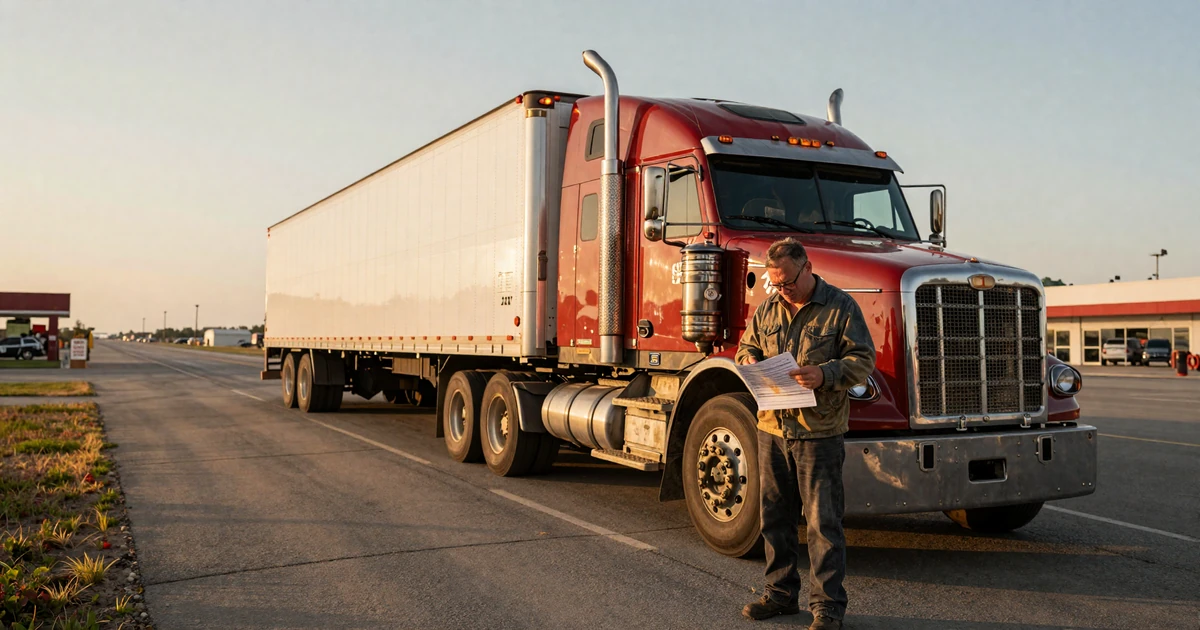
Route Matching Engine
Enter your home base and your recurring corridors - I-35, I-10, I-80 - and the algorithm surfaces partners whose own home or routes intersect yours. Long distance becomes a list of specific stop-overs, not an abstraction.
A swipe-based app is built on one assumption: you can meet in 48 hours. An OTR driver 800 miles from a match, with a home-time window 13 days out, breaks that assumption on day one. The algorithm does the rest - and it doesn't do you any favors.
Generic dating apps fail truck drivers because their algorithms reward two things drivers can't provide: fast replies and short-radius meetups. An OTR driver answering voice notes between resets, 800 miles from a match, gets buried in the feed within days.
Tinder, Bumble, and Hinge don't show you to everyone in your distance radius. They rank profiles by predicted engagement - meaning the system pushes profiles it thinks will get a quick swipe-right and a same-week meetup. That ranking model is the single biggest reason OTR drivers see their match count collapse two weeks into using a generic app.
Here's the thing: the algorithm doesn't know you're a trucker. It just sees the symptoms - slow reply windows, low session frequency, and a location ping that jumps 600 miles between sessions. Each one of those is a signal mass-market apps were built to demote.
The compounding effect is brutal. A driver who would have gotten 30 matches a week on a level playing field sees maybe four - and three of those go cold while the rig is in the middle of Wyoming.
The technical core of every mass-market dating app is a single GPS pin. Trucker reality is a corridor. Those two ideas are physically incompatible - and that gap is where most matches get lost.
A coffee shop in your neighborhood. A 3-mile commute. A 25-mile evening radius. The whole experience is built around the assumption that you and your match will be in the same zip code on Saturday night. When you set "Dallas" as home and the app sees you ping from Toledo, Memphis, and Salt Lake City in the same week, it does the only thing it knows how to do: reset your location and re-show your profile to a city you won't be in for ten more days.
The result is the same conversation, over and over again: "Wait, where are you actually?" By the time you've explained the Toledo ping, the match has gone cold or unmatched entirely.
A home base - say, Dallas - plus a recurring corridor: I-35 north to the Twin Cities, I-20 east to Atlanta, I-10 west to Phoenix. Three weekly opportunity zones, not one pinpoint. The right platform doesn't ask "where are you right now?" It asks "what does your route look like next week?" and matches you with someone whose own home base or route crosses yours.
That's not a feature. That's the entire foundation. Mass-market apps can't bolt it on - it would require rebuilding the matching engine from scratch. See our comparison of dating apps for CDL drivers for which platforms actually do this.
Even when a match does come through on a generic app, a second problem kicks in immediately. You spend the first three days of every conversation explaining what an OTR schedule means, why you can't FaceTime at 9pm Central, what a 34-hour reset is, and why you can't promise dinner this Saturday - or next Saturday, or the one after that.
On a niche platform, the basic understanding is already there. The conversation starts where it should - getting to know each other - not at "let me explain my job for the fourth time this month." - The single biggest reason drivers switch off mass-market apps
This isn't a small thing. Drivers report that explanation fatigue is the number one reason they uninstall Tinder and Bumble - not bad matches, not bots, not pricing. It's the slow drip of having to re-justify the lifestyle to every new stranger, knowing that roughly half of them will ghost the moment they understand what "two weeks out" actually means.
On a niche platform like DatingLawn, the people swiping right on a trucker profile already know what they're signing up for. Some actively prefer the rhythm - independence during the away weeks, real presence during home time. That self-selection alone eliminates 80% of the friction generic apps create.
Industry observers estimate only about 30% of relationship success for drivers comes down to which platform you use. The other 70% is finding a partner who actively wants this lifestyle. A niche platform doesn't change the 70% - it just stops fighting you on the 30%.
The feature gaps are not subtle. They reflect two completely different product philosophies - one built for office workers in dense cities, one built for people who spend two weeks in a sleeper cab.
| Feature | Tinder / Bumble / Hinge | Niche Trucker Platforms |
|---|---|---|
| Matching basis | Static GPS pin, 25-mile radius | Home base + route corridor overlap |
| Reply-time penalty | Yes - slow replies tank visibility | No - asynchronous by design |
| Schedule visibility | None - every match asks again | Driving / resting / home-time status |
| Voice notes | Limited or premium-tier | Built-in, hands-free friendly |
| Meet-up suggestions | Coffee shops near home | Truck-friendly stops along your route |
| Audience self-selection | General public - explain everything | People who already want this lifestyle |
| Profile verification | Photo-based, bot rate ~76% encounter | Driver-aware verification, active moderation |
| Multi-city search | Premium feature, one city at a time | Standard - search the whole corridor |
A niche platform isn't a generic dating app with a truck-themed logo. It's a different matching engine, a different presence model, and a different communication flow. Three features define the category.
Enter your home base and your recurring corridors - I-35, I-10, I-80 - and the algorithm surfaces partners whose own home or routes intersect yours. Long distance becomes a list of specific stop-overs, not an abstraction.
When two users have overlapping schedules at the same truck stop, rest area, or city, the platform flags the opportunity. Coffee at a Pilot in Effingham instead of a fantasy date that never happens.
The chat interface adapts to your status - driving, resting, home time. Voice notes when your hands are busy, text when you can. The algorithm stops penalizing the delays it caused.
None of these features can be bolted onto Tinder. They require a matching engine that treats movement as a primary input, not an edge case. That's the line between a niche dating site and a generic app pretending to serve a niche audience.
The questions drivers ask most often before they switch from mass-market apps to a niche platform.
Yes - several. The niche category includes DatingLawn, TruckerDating.com, DateTruckers.com, and a handful of smaller platforms. The defining feature is route-based matching instead of static geolocation, plus an audience that already understands the OTR lifestyle. The best ones add voice notes, shift-aware chat status, and truck-friendly meet-up suggestions. See our full comparison of dating apps for CDL drivers for the current shortlist.
Yes. The trucker-specific category has grown sharply since 2024, driven by drivers leaving Tinder and Bumble after running into the algorithm and explanation problems described above. Niche platforms typically charge a small subscription or offer freemium tiers - the cost filters out casual users and gives you an audience that actually wants this lifestyle, which is the main reason they outperform generic apps for drivers.
The best site is the one with route matching, voice notes, shift-aware chat, and an active driver-focused community. DatingLawn is built around all four, with a Route Matching Engine and Stopover Connect for coordinating meet-ups along recurring corridors. For a head-to-head comparison of the leading options including TruckerDating.com and DateTruckers.com, see our best dating apps for CDL drivers guide.
Tinder ranks profiles by predicted engagement, and three driver realities tank that ranking: slow reply times (you cannot text behind the wheel), low session frequency (one check after parking instead of five short visits a day), and a location ping that jumps hundreds of miles between sessions. Tinder reads all three as a fading user and stops surfacing your profile to new matches. The app was built for office workers with 25-mile commutes, not for people running 3,000-mile weekly loops.
For active OTR or regional drivers, generally yes. Niche subscriptions typically run $15-$35 per month, and the value comes from two places: the audience already accepts the lifestyle (eliminating the explanation fatigue that drives most generic-app uninstalls), and the matching engine treats your route as an input instead of a glitch. Most niche platforms offer free tiers or trials, so you can test the audience quality before paying. Drivers who quit after one month usually do so because they were not ready for the lifestyle conversation - not because the platform underperformed.
Regular location-based dating uses a single GPS pin and a fixed radius - usually 25 to 50 miles. Route matching uses two inputs: your home base and your recurring corridors (e.g., Dallas home + I-35 north + I-20 east). The algorithm then surfaces matches whose home base or routes overlap yours, even if you are 1,500 miles apart this week. The result is a list of realistic future meet-up opportunities rather than a set of people you happen to be near for 12 hours tonight.