
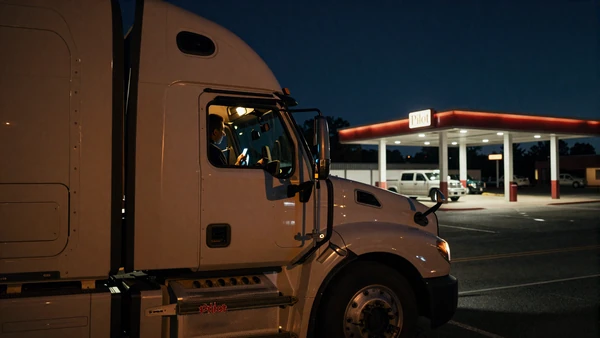
A Community That Gets It
No one asks why you are parked in Amarillo on a Wednesday. The whole user base lives some version of the same schedule, which means real conversations start at message one instead of message ten.
A truck stop at 2 a.m. is one of the quietest places in America. For roughly 28% of drivers, that quiet turns into something heavier. This guide is about why the road gets lonely - and what actually helps, from honest mental-health habits to dating platforms built around how a driver really lives.
Loneliness on the road is not a character flaw or a soft excuse - it is a measurable, well-documented occupational reality. Two numbers in particular tell the story.
Here's the thing: the 40.5% divorce figure tracks closely with the loneliness numbers because the two problems feed each other. A driver who is gone for two or three weeks at a stretch loses casual day-to-day contact with a partner. Casual contact is what most relationships actually run on. When it disappears, the relationship either adapts - or it slowly comes apart at the seams.
That is not the end of the story. The same body of research shows that drivers with strong relationship support score measurably better on mental-health metrics and on-road safety scores. Connection is not a luxury for a CDL holder. It is part of the safety equipment.
Drive My Way's editorial team put it plainly in a 2025 piece on OTR dating: the schedule is the schedule. Long days behind the wheel, nights on the lot, and weeks at a time away from home. Most drivers describe a familiar cycle - energetic the first three or four days out, steady through the middle of a haul, then a slow emotional fade in the final stretch where the silence at a Pilot or a Flying J starts to weigh more than the miles do.
Three structural realities create the quiet:
"It is not that nobody wants to talk to me. It is that by week two, I do not have the energy to explain myself one more time. So I just keep the radio on and let the parking lot stay quiet." - Anonymous OTR driver, 12 years CDL, in a 2025 Drive My Way reader survey
Partners feel it too. Many describe their role using almost the exact phrasing of military spouses: full responsibility for home, kids, and household logistics while their person is out of reach. That is a real load, and pretending otherwise has never helped anyone. For a longer read on the daily texture of OTR relationships, see our piece on life on the road and dating.
Niche dating platforms work for drivers because they remove the social friction Michael Carter of Passions Network calls "the explaining tax." When an app already knows you live on the road, every conversation starts past the objection - not before it. Industry data shows niche dating platforms post about 30% higher daily engagement than transactional generic apps for exactly this reason.
No one asks why you are parked in Amarillo on a Wednesday. The whole user base lives some version of the same schedule, which means real conversations start at message one instead of message ten.
Voice notes, delayed replies, and "driving / parked" status flags are built in. The algorithm does not punish you for a six-hour response gap, because that is what life behind the wheel actually looks like.
Your home base plus your usual lanes - I-35, I-10, I-80 - go into the matching engine instead of a single static GPS pin. You see people who are already on your road, not just the ones within a 50-mile radius of an empty cab.
A 2025 review of niche dating platforms identified three deciding factors for drivers picking a long-term home: geographic flexibility (multi-state and multi-route search), no paywall on basic messaging, and a mobile build that loads on weak truck-stop Wi-Fi. Apps that miss any of the three get uninstalled within a week.
Two stories from the DatingLawn community - pulled with permission from longer interviews on our success stories page.
Three years of feeling invisible on Tinder. Two months on a route-matching app and I met Renee - she is an ICU nurse in Macon who runs nights, so our weird hours actually line up. We have been together fourteen months. The quiet at the truck stop does not feel the same anymore.
I was honest in my profile - I work nights, I do not want anyone underfoot during the day, and I respect a man with a real job. Within a week I had three real conversations with drivers. Marcus was the one who actually called me on his break instead of just texting. That tells you everything.
Dating apps are part of the picture, not the whole picture. Driver forums and partner groups consistently surface the same short list of habits that lower the emotional load of long hauls. None of them are heroic. All of them work.
Online communities and dating platforms help with everyday loneliness. They are not a replacement for professional care when something heavier is going on. If you or someone you ride with is in crisis, the 988 Suicide & Crisis Lifeline is free, 24/7, and confidential - by call or text.
The questions drivers and partners ask most often about loneliness, mental health, and modern trucker dating.
Yes - several. DatingLawn is built specifically around route matching, async messaging, and verified CDL profiles, with a free-forever tier that lets drivers test the platform on truck-stop Wi-Fi before committing. Other niche options include TruckDriverDating.site and WeTrucker.com. The category exists precisely because mainstream swipe apps penalize CDL holders for distance and slow response time.
It is different, not necessarily hard. The two real demands are flexibility - dispatcher delays and route changes will move plans - and comfort with asynchronous communication. Partners who do well tend to have their own busy lives and value the kind of intentional, focused time a driver brings home between hauls. The relationship runs on quality of contact more than quantity.
Peer-reviewed research puts driver loneliness at about 28% and depression at 27%. The structural causes are time-zone drift, the constant "explanation tax" of describing your schedule to new people, and dispatcher unpredictability that erodes social plans. Long stretches away from home also limit the casual day-to-day contact that most relationships and friendships actually run on.
It can, and the data backs it up. Drivers who report strong relationship support also score higher on mental-health and on-road safety measures. The couples who succeed share three habits: a daily anchor check-in, multi-channel communication (text plus voice plus video), and protected home time when the haul ends. Tools that respect those rhythms - including route-aware dating platforms - make all three easier.
Treat it the way you would treat a check-engine light - do not ignore it. Two weeks of low motivation, sleep changes, or persistent dark thoughts is a medical signal, not a character issue. Call or text 988 for the Suicide & Crisis Lifeline (free, 24/7, confidential), talk to your dispatcher about a home-time reset, and consider a telehealth therapy app you can use from the cab.