Relationships · 9 min read

How to Keep Love Strong Through Every Long Haul

If your boyfriend is a truck driver - or you are married to one - these are the daily habits, communication channels, and home-time rituals that actually keep couples together past the three-month mark.

The short version
  • Three daily check-ins beat one long call. A morning text, a midday voice note, a parked-truck video call at night - predictable beats spontaneous.
  • Mix your channels. Text for logistics, voice for stories, video for faces. One channel alone always misses something.
  • Protect home time. Clear the calendar for the first 24 hours, pick two must-do tasks, save one tech-free evening.
  • Trust is the foundation. Eyes on the road. No wandering. No reasons to wonder. Build it early, protect it always.
The whole game

Why Communication Is the Whole Game

Dating someone who travels for work is hard. Dating someone who is gone for 14 to 21 days at a stretch, behind the wheel of an 80,000-pound rig, with patchy cell signal and a dispatcher who reroutes him at 4 a.m. - that is a different sport entirely. The relationships that survive long hauls all share one thing: a communication rhythm that does not depend on either partner being in a good mood that night.

Researchers studying driver wellbeing keep finding the same pattern. Drivers who receive consistent family support and structured emotional contact show better safety records, lower turnover, and lower rates of depression. Their partners, in turn, report higher relationship satisfaction the longer the couple has been together - usually starting around the three-month mark, when the shock of the schedule wears off and the routines kick in. None of this happens by accident. It happens because two people built a system.

The good news: the system is not complicated. It is just five habits, repeated until they feel automatic. Here they are, in the order most couples adopt them.

Habit one

The Daily Check-In Rhythm That Works

Short, regular, predictable. Three small touchpoints a day beat one big call every few nights - every time. The trick is picking a rhythm and protecting it like a route schedule.

Morning Text

A two-line message before the wheels roll. "Good morning. Coffee strong, signal weak today, talk at lunch." It takes ten seconds and tells your partner the day has started together. Keep it logistics-light - this is for connection, not coordination.
Midday Voice Note

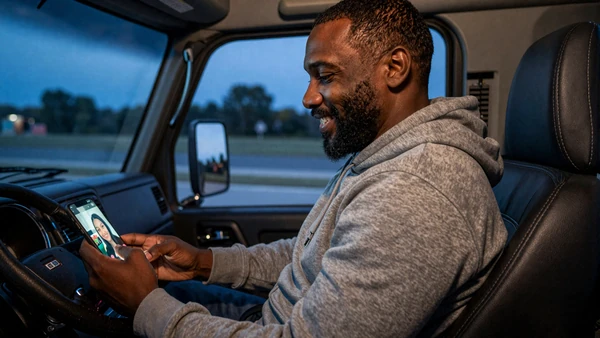
Thirty to sixty seconds, recorded at a fuel stop or a shipper. One real thing from the day: the sunrise over Amarillo, the diner waitress who remembered him, the song that came on. Voice carries tone that text can never reach.

Goodnight Video Call

10 to 15 minutes after he parks for the night, usually 9 to 10 p.m. Structure it: a feelings check, one specific story from the day, a moment of affection, the next-day logistics. Short calls done daily beat long calls done weekly.

Couples who follow long-distance research from relationship coaches consistently find that consistency matters more than duration. A reliable 12-minute call at 9 p.m. every weeknight builds more security than an unpredictable 90-minute call once a week. Pick the time. Defend the time.

Habit two

Mixing Texts, Voice Notes & Video Calls

Relying on a single channel is the most common mistake new trucker couples make. Text-only relationships go cold by month two - too much emotional nuance gets lost between the lines. Video-call-only relationships collapse the first time dispatch reroutes him through a stretch with no signal. The couples who last use every tool in the box, each for what it does best.

  • Text - short logistics, ETA updates, "I love you" before bed. Fast, silent, easy to send between gears.
  • Voice notes - longer stories he wants to tell when typing is unsafe or annoying. WhatsApp, iMessage, and Telegram all do this well. He can record while parked; you can listen while doing dishes.
  • Video calls - faces. Eyes. The tone behind the words. Schedule these for after the truck is parked. FaceTime and Skype both work on weak signals; Zoom is fussier.
  • Handwritten notes - slip one into his lunch bag before he leaves, or mail one to a terminal he will hit Thursday. Drivers keep these in the visor for months.
"He sent me a photo from a rest area in Nevada - just the sunset, no words. I screenshotted it. Three years later it is still my lock screen." - Marisol, married to a regional driver, California

Small gestures travel farther from the road than from anywhere else. A Post-it tucked inside a sandwich. A shared Spotify playlist you both add to during the week. A care package routed to a truck stop he will hit Thursday afternoon. None of these cost much. All of them say I am thinking about you while you are gone, which is the only message that actually matters.

Habit three

Planning Home Time So It Doesn't Burn Out

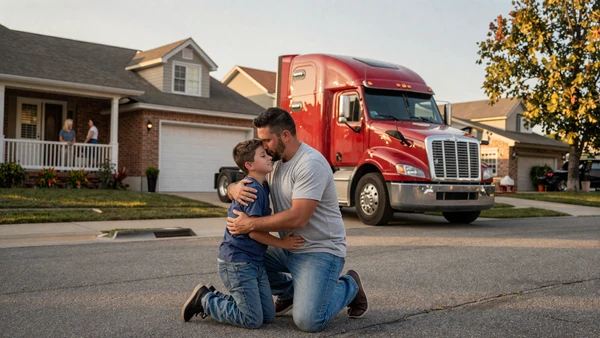
A three-day home visit after two weeks on the road is precious - and weirdly fragile. Overpacked calendars are the silent killer. The goal is presence, not productivity.

The mistake almost every couple makes early on: trying to cram a normal life into 72 hours. Two birthday parties, dinner with the in-laws, the oil change he promised, three errands you saved up, plus "real time together." By Sunday night nobody has actually rested, and the next 14 days on the road start in a hole.

What works instead is brutal selection. Pick two must-do tasks for the visit - one personal, one practical. Everything else either waits or gets handled by you while he is on the road. Protect the first 24 hours from anything beyond resting, eating, and being in the same room. Keep one evening completely tech-free for an actual conversation.

And build a fallback. Freight delays will eat one home-time visit in three. When his Friday arrival becomes Sunday morning, the couples who have a "Plan B weekend" sketched out - a low-key version of the original plan - adjust without resentment. The couples who treated the original plan as sacred end up fighting.

  • Clear the calendar for the first 24 hours - no errands, no visitors
  • Pick exactly two must-do items for the visit, not eight
  • Split household tasks so home time is not just another shift
  • Protect one tech-free evening for an actual conversation
  • Keep one small ritual per visit (Sunday breakfast, neighborhood walk)
  • Sketch a Plan B in case freight delays the arrival
  • Let him sleep in on day one - chores can wait until day two

For a deeper look at how schedule type changes the math, read our piece on balancing trucking schedules with relationships - OTR, regional, and local each need a different home-time playbook.

Habit four

Small Gestures From the Road That Mean Everything

Long-distance relationship research consistently points to a counterintuitive finding: anticipating something specific does more for connection than the event itself. Booking the dinner reservation for next Saturday lifts mood across the entire week leading up to it. That is leverage every trucker couple can use.

Plan small, concrete things waiting for home time. A new restaurant you have been eyeing in Dallas. A short hike at a state park neither of you has visited. A local concert on a Tuesday - perfectly timed because regional drivers are usually home midweek. Tell him about it on the Monday call. The expectation becomes a thread he can hold onto across the next 1,400 miles.

"We book one small thing every home time - a brewery, a movie, a drive somewhere new. It is never expensive. It is always something to look forward to." - Tasha, partner of an OTR driver, Atlanta

The gestures going the other direction matter just as much. A photo of the dog at 7 a.m. A screenshot of the front porch in the rain. A voice note saying you saw his favorite cereal on sale and bought three. None of it is grand. All of it says the same thing: your home is still your home, and someone is in it thinking about you. That message, repeated three or four times a day, is what carries a relationship through 14-day absences.

If you want a full breakdown of the OTR communication playbook, our guide on long-distance relationships with truckers goes deeper on shifted holidays, time-zone tactics, and the rituals that travel best across state lines.

Habit five

Trust Is a Must: The Non-Negotiable Foundation

Every habit above is built on one assumption: both people in the relationship are trustworthy. Without that, no rhythm of check-ins or volume of voice notes will close the gap. With it, even rough weeks find their way back.

Keep your eyes on the road.

Both meanings. Eyes forward when the wheels are turning, eyes forward when you are off the truck. Trust is not a feeling that visits - it is a discipline maintained over thousands of miles.

Truck stops, hotel bars, and lonely evenings test long-haul relationships in ways desk jobs never do. Drive My Way put it bluntly in their trucker-relationship guide: trust is built early, protected daily, and lost in a single screenshot. The partners back home face the same test from the other side - late nights alone, friends who do not understand the rhythm, the slow drift of "he is never here anyway." Both directions need the same answer: clear boundaries, honest conversations when something feels off, and no patience for grey areas.

Pair that with the communication system above, and you have something most relationships do not: a trucker couple that lasts past the first hard year.

PAA

Frequently Asked Questions

The questions partners send us most often - answered straight.

Is it hard to be in a relationship with a truck driver?

Being in a relationship with a truck driver is hard in different ways than most relationships. The biggest challenges are emotional - missing holidays, eating dinner alone, anxiety about schedule changes - rather than logistical. What makes it work is treating unpredictability as a logistics issue (dispatch decisions, weather, freight delays) instead of a personal slight, and building strong individual routines so your life does not pause when he is on the road. Most partners report the rhythm clicks around three months.

Is it hard to date a truck driver?

Dating a truck driver requires independence, patience with asynchronous communication, and comfort with schedule unpredictability. OTR drivers are out 2 to 3 weeks at a time, regional drivers come home most weekends, local drivers are home every night but work 10 to 14 hour days. The compensations are real - undivided attention during home time, stable CDL income, and a partner who values your time together because it is rare. The first three months are the hardest; couples who get through that usually stay.

How often should we talk when he is on the road?

Most successful trucker couples talk three times a day in different formats - a morning text, a midday voice note, and a 10 to 15 minute video call after he parks for the night. Consistency matters more than duration. A reliable 12-minute call every weeknight at 9 p.m. builds more security than an unpredictable 90-minute call once a week. Pick a rhythm that works for both schedules and protect it like a route plan.

My boyfriend is a truck driver and I feel lonely - is that normal?

Loneliness is the most common feeling partners of OTR drivers report, and yes, it is completely normal in the first few months. The partners who manage it best build a full independent life - strong friendships, hobbies that do not require him, routines that do not pause when he is gone. The relationship benefits when both people have their own world. If loneliness slides into depression or constant anxiety, talk to a counselor familiar with shift-work families; many drivers carry mental health benefits through their employer that cover spouses.

How do we celebrate holidays and birthdays when he is always gone?

Successful trucker couples celebrate when home time lands, not when the calendar says. If Thanksgiving is mid-haul, the dinner moves to the Sunday before he leaves or the weekend after he returns. Pick a real date and an official date - your real date is the one that matters. Couples who insist on the calendar version of holidays burn out fast; couples who shift gracefully build their own traditions that often end up more meaningful than the originals.

What is the best way to surprise a trucker on the road?

Small and routed. A care package mailed to a terminal he will hit on Thursday. A handwritten note tucked into his bag before he leaves. A Spotify playlist you build together during the week. A photo of the front porch in the morning rain. Skip grand gestures - they often arrive at the wrong stop or get crushed in the trailer. The drivers who feel most loved on the road are the ones who get small, frequent reminders that home is still waiting.

Find Partners Who Get the Long-Haul Life

Verified profiles, route-aware matching, and shift-aware chat that adapts to driving and resting states. Built for couples ready to do the long-haul thing right.

Free forever · No credit card · US-based support